


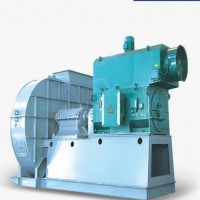


Pressure range: under 20000Pa
Flow rate: 800000 m3/h
Temperature: 450℃ within
Features:
High transmission efficiency, safe and reliable, stable operation, and easy installation
The characteristics of D-type centrifugal fans mainly include the following aspects:
Transmission method: The transmission method of D-type centrifugal fan adopts coupling transmission. The motor and fan are connected and driven through the coupling, and the impeller is installed in a cantilever manner. This transmission method has the characteristics of high transmission efficiency, safety and reliability, relatively stable fan operation, and easy installation. It is suitable for medium-sized fans and is widely used.
Operational stability: D-type centrifugal fans have high operational stability, suitable for continuous operation, and do not require frequent belt replacement or adjustment of belt tension, reducing maintenance costs.
Noise and vibration: D-type centrifugal fans have low noise and small vibration, making them suitable for occasions with high requirements for noise and vibration.
Scope of application: D-type centrifugal fans are suitable for various ventilation and induced draft situations, especially for high air volume and high air pressure situations, such as large boiler induced draft fans and desulfurization and dust removal environmental protection equipment.
Maintenance: The structure of D-type centrifugal fan is relatively simple, easy to maintain, and reduces maintenance costs and time.
In summary, D-type centrifugal fans have performed well in industrial applications due to their efficient transmission mode, stable operating performance, low noise and vibration, wide applicability, and convenient maintenance.